FOLLOW ONE QUESTION
How Do I Actually Read My Birth Chart?
On This Trail
You don’t have to understand the whole map to know where to begin.
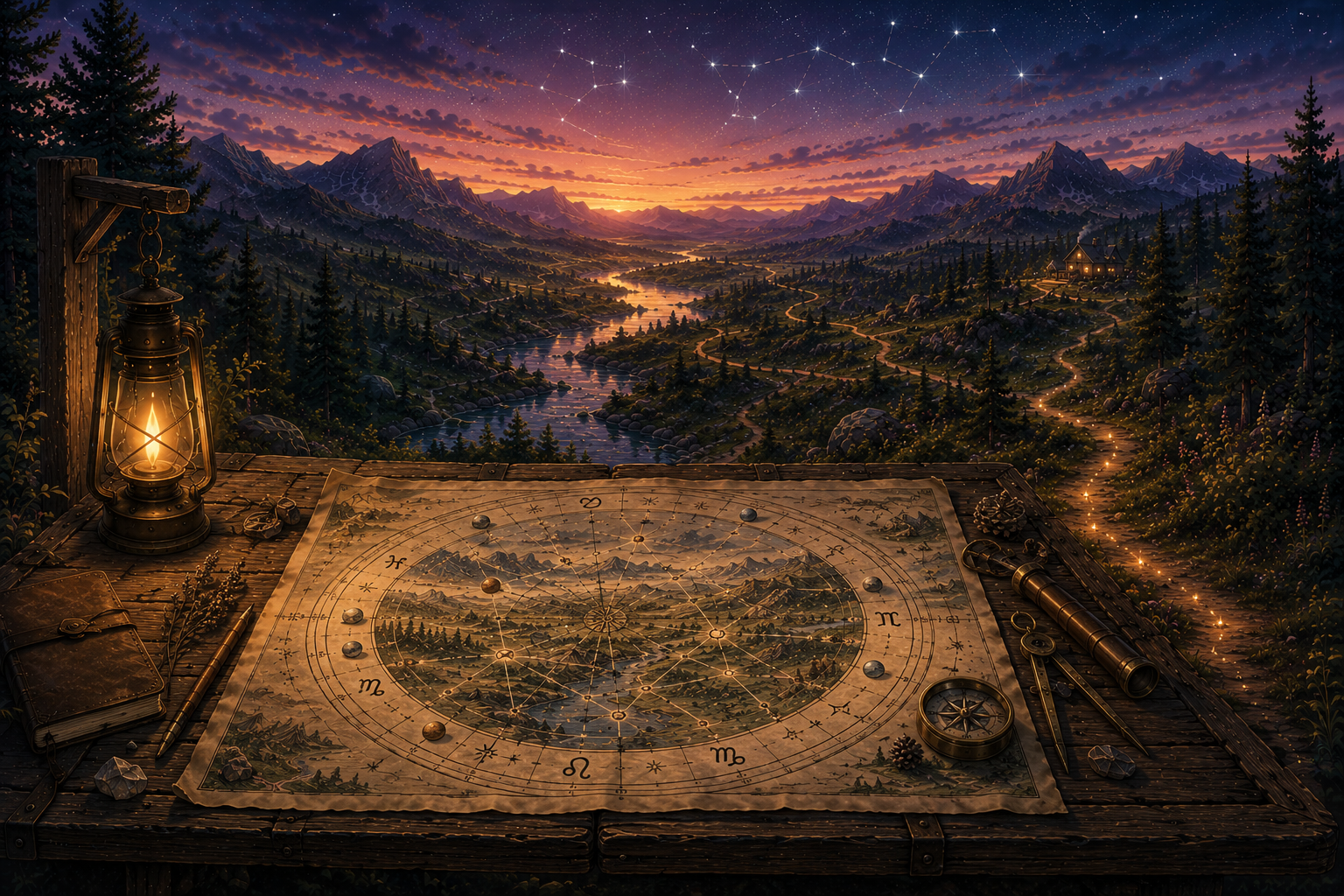
You pull up your birth chart and suddenly there are twelve sections, a collection of symbols, colored lines running everywhere, degrees, planets, signs, houses, and probably several things you have never seen before.
And somehow you’re supposed to look at all of that and recognize yourself.
No wonder so many people stop at their Sun sign.
The good news is that you do not need to understand everything in your birth chart to begin reading it.
A birth chart makes much more sense when you stop treating it like a list of personality traits and start treating it like what it actually is: a map.
And maps are meant to be read a piece at a time.
First: What Is a Birth Chart Actually Showing You?
A birth chart is a symbolic map of the sky calculated for the moment and location of your birth.
Astrologers use that map as a framework for exploring patterns, tendencies, tensions, strengths, needs, and different areas of life.
But that distinction matters.
Your chart does not automatically prove who you are.
It offers symbolic possibilities.
Your lived experience helps determine how, whether, and where those possibilities actually belong in your story.
That is one of the reasons two people can have the same placement and experience it very differently.
It is also why Stone & Sky does not approach a chart like a cosmic personality test where every placement is supposed to describe you perfectly.
The chart gives us the map.
The person tells us what the landscape is actually like.
The Four Pieces You Need to Start Reading a Birth Chart
Most of what you’re looking at can initially be understood through four questions:
Planet: What part of the map am I looking at?
Sign: How might that part express itself?
House: Where in life might I encounter it?
Aspect: How does it interact with other parts of the map?
You don’t need to memorize every possible meaning yet.
Start with the structure.
1. Planets: What Are We Talking About?
In astrology, planets represent different functions, drives, needs, or parts of human experience.
For example, the Moon is commonly associated with emotional needs, instinctive responses, comfort, and security. Mercury is associated with thinking and communication. Mars can describe drive, assertion, motivation, and how we move toward something.
Instead of reading:
“My Mars is Pisces, so I am ______.”
try beginning with:
“If Mars represents drive and action, what might my chart be suggesting about the way I experience that part of myself?”
That small shift turns a label into a question.
And questions are much more useful when you’re learning your map.
2. Signs: How Might It Express Itself?
The sign gives us another layer.
If the planet tells us what we’re looking at, the sign helps describe how that energy might operate or express itself.
This is where astrology often gets flattened into personality descriptions.
A sign does not mean everyone with that placement behaves the same way. It gives us a symbolic language for exploring how that particular part of the chart may function.
And even the signs you see in your chart can change depending on which zodiac system is being used.
That doesn’t necessarily mean one chart is correct and another is wrong. It means understanding how your map was calculated matters before you begin interpreting what is on it.
3. Houses: Where Does This Show Up?
Now we add location.
The twelve houses divide the chart into different areas of life.
Depending on the house, the symbolism might involve things like identity, resources, communication, home, relationships, work, community, inner life, or other parts of human experience.
So now instead of reading one isolated placement, you can begin putting together a sentence:
Planet = what
Sign = how
House = where
This is also why accurate birth information can matter so much. Your birth time helps determine the Ascendant and house structure of the chart.
If you don’t know your exact birth time, that does not mean you cannot explore astrology at all. It simply changes which parts of the map can be interpreted with confidence.
4. Aspects: How Do the Different Parts Talk to Each Other?
This is where those lines across the middle of many birth-chart wheels come in.
Aspects describe relationships between different points in the chart.
Rather than treating your Moon, Mercury, Mars, Saturn, and everything else as separate personality traits, aspects help show how different parts of the symbolic map may support, challenge, amplify, or complicate one another.
And this is where a birth chart begins becoming something much richer than a collection of placements.
You are not twelve signs, ten planets, and a pile of disconnected descriptions.
The pieces belong to the same map.
Want to understand this part more deeply? Read How Do All the Parts of a Birth Chart Work Together?
Why Do Different Birth Charts Sometimes Look Different?
Before you panic because one website gave you one Rising sign and another gave you something else, remember that astrology calculators can use different settings.
Different zodiac systems, house systems, calculation choices, birth information, or default settings can change what appears on the chart.
That is why it helps to know which map you’re actually reading before trying to interpret it.
The Part a Birth Chart Cannot Tell You
This may be the most important part of learning to read one.
A chart can give you symbolism.
It cannot tell us, by itself, exactly how that symbolism has lived inside a human being.
A placement may describe several possible expressions. Family, culture, relationships, neurotype, environment, experiences, choices, and countless other parts of a person’s life can affect how that symbolism is experienced.
That is why Stone & Sky uses the Human Translation Method.
We look at the symbolic possibilities in the map alongside the person’s actual lived experience.
When the two recognize each other, we have something worth exploring.
When they don’t, we don’t force the person to fit the chart.
The map is there to help us understand the traveler. The traveler is not there to prove the map right.
The map is there to help us understand the traveler. The traveler is not there to prove the map right.
You Don’t Have to Read the Whole Map
This is where beginners often get stuck.
They think learning astrology means eventually being able to look at the entire wheel and understand everything happening at once.
You don’t have to start there.
Start with one question.
Maybe you want to understand why communication sometimes feels harder than it seems like it should.
Maybe you’re curious about your emotional patterns.
Maybe you’re trying to understand why certain parts of your chart feel immediately recognizable while others feel completely foreign.
Choose the question first.
Then look at the parts of the map that might help you explore it.
You can learn the landscape by walking one trail at a time.
Want Help Finding Your Bearings?
If you’ve looked at your birth chart and thought, “Okay… but what does any of this actually mean for me?” the Stone & Sky Compass was built for that beginning.
The Compass is a personalized orientation to your map. Rather than handing you a collection of placement definitions and expecting you to figure out how they belong together, it uses your birth chart, your own words, and the Stone & Sky Human Translation Method to help you begin recognizing the landscape you’re actually standing in.
You don’t need to know astrology before you begin.
You just need to be curious about your own map.