FOLLOW ONE QUESTION
Is Astrology Really Real?
On This Trail
That depends on what you mean by “real.”
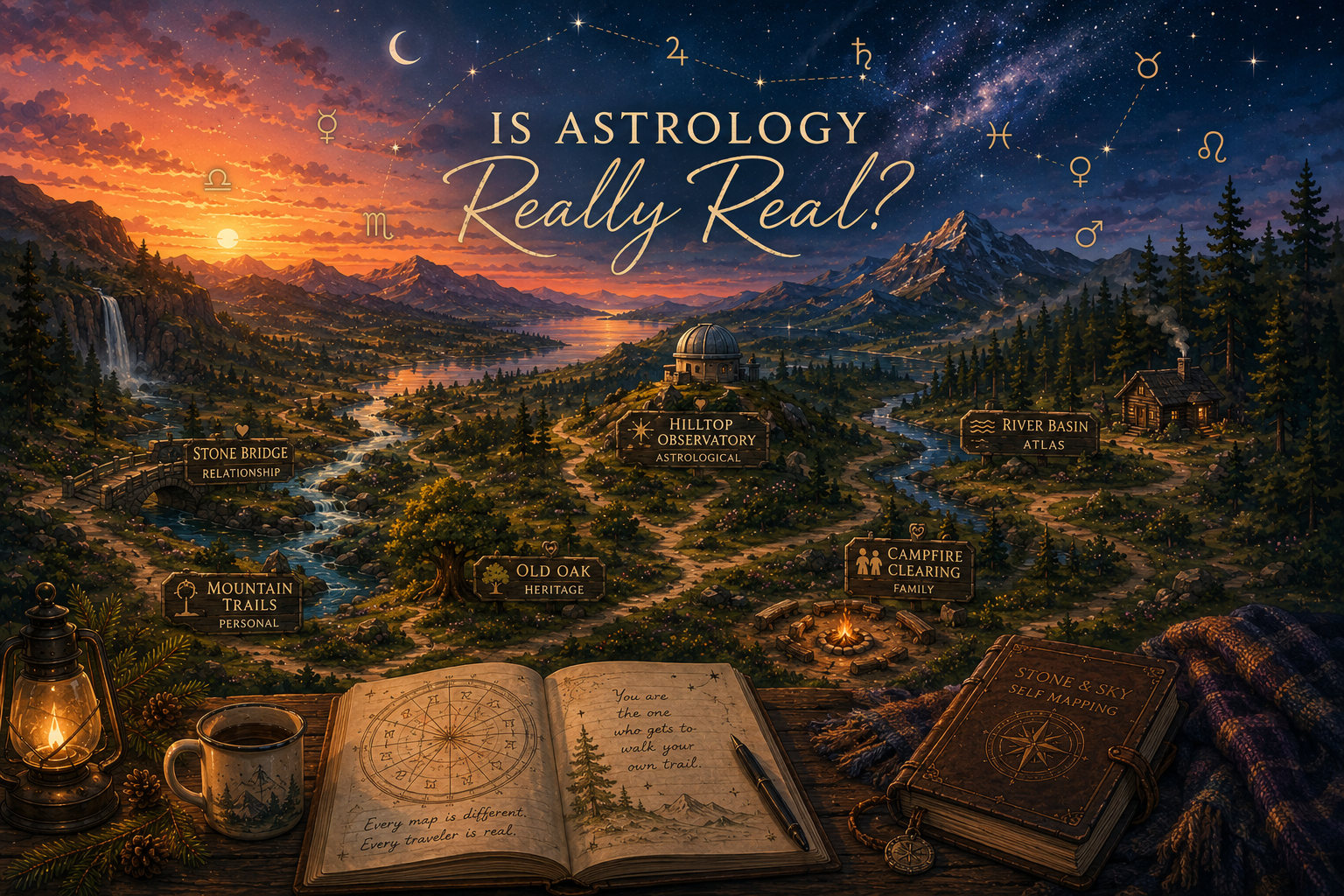
It is one of the biggest questions hanging over astrology.
Is it real?
Does a birth chart actually describe you?
Do planets somehow cause personality traits?
Can astrology predict what is going to happen?
And if there is no scientific proof that the position of the planets determines who someone becomes, does that mean astrology has no value at all?
Stone & Sky does not think those questions need to be avoided.
They need to be separated.
Because “Is astrology real?” can actually mean several very different things.
Astrology Is Not Scientific Proof of Personality
There is not strong scientific evidence showing that a birth chart can prove someone’s personality, determine their future, or establish that planetary positions cause specific human traits.
Stone & Sky does not present astrology that way.
It is a symbolic system.
That distinction matters.
Astrology has developed over thousands of years as a language of symbols, patterns, cycles, archetypes, and interpretation. Different traditions use that symbolic language in different ways.
That is very different from saying:
“This placement proves that you are this kind of person.”
Stone & Sky does not make that claim.
So Why Use Astrology at All?
Because something does not have to function as scientific proof in order to be useful as a reflective framework.
Stories can help us understand ourselves.
Metaphors can give language to experiences that were difficult to describe.
Questions can help us notice patterns.
Symbols can give us another angle from which to examine something we already live every day.
Astrology can be used in that same way.
The value is not necessarily in proving that a symbol is objectively true.
The value can be in asking:
“Does this give me a useful way to look at something I recognize in myself?”
That is a very different relationship with astrology.
Symbolic Possibility Is Not the Same as Fact
This distinction sits at the center of the Stone & Sky Human Translation Method.
A birth chart can suggest symbolic possibilities.
Your lived experience provides evidence, context, contradiction, and meaning.
For example, an astrological interpretation might suggest that a certain placement can relate to direct communication.
That does not mean the person must communicate directly.
Maybe they do.
Maybe they learned early that directness was unsafe.
Maybe they are direct in one environment and extremely careful in another.
Maybe the symbolism shows up somewhere else entirely.
Or maybe the interpretation simply does not fit.
Stone & Sky does not force the person to match the symbol.
We look at the map, then we look at the person.
If there is recognition, we explore it.
If there is not, we do not pretend there is.
A Useful Map Does Not Have to Be the Landscape
Imagine looking at a trail map.
The map is not the mountain.
It is not the river.
It is not the weather, the loose stones, the sound of the forest, or the experience of actually walking the trail.
It is a representation.
A way of organizing information.
A tool that may help someone notice where they are and where they might look next.
Stone & Sky approaches astrology similarly.
The birth chart is not the person.
It is not their childhood, nervous system, relationships, choices, culture, identity, history, or lived experience.
It is one symbolic map.
And symbolic maps are most useful when we remember that they are maps.
What About Predictions?
This is another place Stone & Sky draws a firm boundary.
Stone & Sky does not use astrology to tell people what will happen to them.
We do not use a birth chart to declare who someone is destined to become.
We do not use it to decide whether two people should be together.
We do not treat transits, placements, or chart patterns as unavoidable fate.
Astrology can be explored as symbolism, reflection, timing traditions, or a language for noticing patterns without turning it into certainty about the future.
Curiosity and certainty are not the same thing.
What Makes Astrology Feel Accurate Sometimes?
This is where things get interesting.
Sometimes people read an astrological interpretation and feel an immediate sense of recognition.
Other times they read something and think:
“That is absolutely not me.”
Both experiences matter.
Recognition can come from many places.
A description may genuinely capture something someone has noticed about themselves.
It may use language that helps organize an experience they never had words for.
It may be broad enough that many people relate to it.
It may resonate because the person is already looking for a particular pattern.
And sometimes an interpretation simply misses.
Stone & Sky does not need astrology to be perfect in order to use it thoughtfully.
The important question is not:
“Can I prove this symbol is objectively true?”
It is:
“What happens when I place this symbolic possibility beside the life I have actually lived?”
That is where Human Translation begins.
You Are Allowed to Be Skeptical
You do not have to believe that astrology controls your personality in order to explore a birth chart.
You do not have to treat every placement as fact.
You do not have to choose between unquestioning belief and dismissing the entire symbolic system.
You can be curious.
You can question.
You can notice what resonates.
You can leave behind what does not.
You can ask whether a symbol gives you useful language without deciding that the symbol caused the experience.
That middle ground is where Stone & Sky lives.
The Question Stone & Sky Actually Asks
Stone & Sky is less interested in proving that astrology is “real” in the way people often mean that word.
We are much more interested in another question:
“Can this map help you recognize something real about the life you are already living?”
Sometimes the answer is yes.
Sometimes it is no.
And the person gets to decide.
The map does not outrank the traveler.
Curious What Your Own Map Might Help You Notice?
The Stone & Sky Compass is designed as an orientation to your individual map.
It brings your birth chart together with your own words, experiences, and questions through the Human Translation Method.
You are not asked to accept every placement as truth.
You are invited to explore what creates recognition, what raises questions, and what helps you understand your own landscape more clearly.
The goal is not belief.
The goal is understanding.